Speaking 4
Master OET Speaking skills with AI chatbot practice, role-plays, and patient-centered communication for vaccination cases.
Learning Objectives
Learning Objectives
By the end of this chapter, students will be able to:
- C1 Identify the structure and criteria of OET Speaking.
- C2 Explain patient-friendly vocabulary based on the vaccination case context.
- C2 Explain grammar, and empathy strategies
- C3 Apply appropriate language in structured speaking tasks using chatbot
- C4 Analyze patient needs and emotional cues and do a roleplay with the chatbot.
- C5 Evaluate or reflect on their learning experience by identifying useful vocabulary, evaluating their grammar and speaking confidence, describing areas for improvement, and explaining how the AI chatbot supports their English learning development.
- C6 Produce a clear, empathetic, and coherent OET role-play.
Pre-Class Activities
Overview
1. Overview of the Speaking Sub-Test
The OET Speaking test has a short warm-up (not scored) and two role-plays. In each role-play, you act as a healthcare professional, and the examiner is the patient or carer. Before speaking, you have 3 minutes to prepare. During this time, read the situation, understand your role, check the patient's problem, and think of simple phrases to use. During the role-play, start with a polite greeting, ask simple questions, and show empathy. Give clear explanations and advice using easy and polite language. Do not speak too directly. Also, give the patient time to respond and keep the conversation natural. To improve, practice role-plays, learn useful phrases, and remember that effective communication is more important than perfect grammar.
To have a better understanding of Speaking subtest, watch this video:
To identify how well you understand the video, answer questions in the following link:
 Quiz
Quiz OET Speaking Blueprint: Clinical Dialogue Framework
The OET Speaking Blueprint: Beginner's Clinical Dialogue Guide provides a standardized, six-step framework designed to facilitate clear and professional communication between healthcare providers and patients.
OPEN → ASK → EXPLAIN → REASSURE → ADVISE → CLOSE
The framework prioritizes polite engagement, systematic information gathering, and structured delivery of medical information. Key takeaways include the differentiation of dialogue based on clinical setting (clinic vs. hospital) and a specific pedagogical model for explaining medical conditions: linking cause, symptoms, treatment, and preventative advice in a logical sequence.
For further explanation: 📄 Download Framework PDF
2. Criteria of Speaking Sub-Test
The OET speaking subtest is assessed based on two main areas: language skills and clinical communication. Language skills focus on how clearly and smoothly you speak, including clarity (easy to understand), fluency (natural speed), appropriateness (using the right tone), and accuracy (correct grammar and vocabulary).
Clinical communication measures how well you interact with the patient, such as building a good relationship, understanding the patient's feelings, organizing the conversation clearly, and giving and gathering information effectively. To get a good score, you need to speak clearly, use simple and correct language, show empathy, and guide the patient step by step during the conversation.
For further explanation: 📄 Download Scoring Guide
Vocabulary
3. Key Vocabulary for OET Speaking
Core Vocabulary List (Patient-Centered Language)
This module focuses on developing students' language skills and clinical communication when discussing vaccination. To support this learning, the following key vocabulary items will help you communicate more effectively during practice sessions with the chatbot and your classmates. Read and understand them carefully before the class session.
🔑 15 Key Vocabulary Items
| No. | Vocabulary | Meaning (Simple) | Example Sentences |
|---|---|---|---|
| 1 | Vaccination | medicine to prevent disease | Your child needs a vaccination today to stay protected. |
| 2 | Concerned | worried | I understand that you are concerned about your daughter's health. |
| 3 | Reassure | make someone feel less worried | Let me reassure you that the vaccine is safe. |
| 4 | Rare | not common | Serious side effects are very rare. |
| 5 | Side effects | extra effects from medicine | Some children may experience mild side effects after the vaccine. |
| 6 | Mild | not serious | These side effects are usually mild and go away quickly. |
| 7 | Options | different choices | Let me explain the options available for your child's vaccination. |
| 8 | Records | official documents | Please bring your child's medical records for review. |
| 9 | Measles | infectious disease | This vaccine helps protect your child from measles. |
| 10 | Brochures | information papers | I will give you some brochures with more information. |
| 11 | Protect | keep safe from harm | Vaccines help protect your child from serious diseases. |
| 12 | Infection | illness from germs | Vaccination can reduce the risk of infection. |
| 13 | Symptoms | signs of illness | If you notice any unusual symptoms, please contact us. |
| 14 | Prevent | stop something from happening | Vaccines are important to prevent serious illnesses. |
| 15 | Immunity | body protection from disease | This vaccine helps your child build strong immunity. |
🔑 Key Vocabulary and Useful Phrases for Speaking Subtest
You will also learn important vocabulary and useful phrases for the OET speaking subtest. The following video explains common verbs and expressions that often appear on the role-play card, such as explain, reassure, suggest, and recommend. You will also learn how to ask questions politely, give information clearly, and speak in a friendly and professional way with patients. By watching this video, you will better understand what to say during the speaking test and how to communicate more naturally and confidently.
Click the following icon to watch it.
✍️ Vocabulary Exercise
To identify how well your understanding of the vocabulary is, take the following quiz:
 Vocabulary Quiz
 Grammar
4. Grammar for OET Speaking
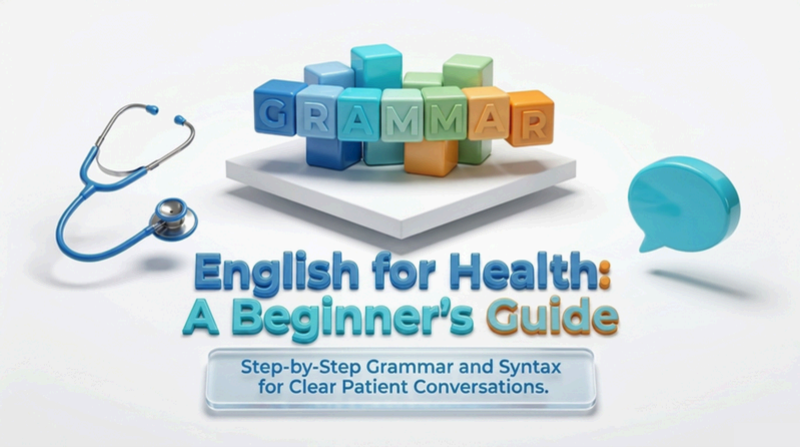
In OET Speaking, you should use simple, clear, and structured grammar to communicate effectively with patients. Good communication depends on two things: using correct language and showing care to the patient. You need to speak clearly, use simple sentence structures, and organize your ideas step by step. Use an easy pattern like Subject + Modal + Verb + Object (e.g., I need to check your leg first) to make your speech polite and clear.
Subject + Modal + Verb + Object e.g., I need to check your leg first Use modal verbs like can, should, need to, and cannot to sound more polite, especially when giving advice or refusing requests. You can also use simple if-sentences (first conditional) to explain risks, such as what may happen if a patient takes certain medicine. The key idea is to speak in short, simple sentences, use everyday words, and avoid complicated grammar so the patient can easily understand you.
📌 Instruction for Students:
Please read this full file carefully to learn the grammar patterns in detail. This will help you speak more clearly and confidently in the OET Speaking test.
Or you can watch a video here:
Practice with AI Chatbot
5. Practice with AI Chatbot
Read the following cue card. Read it carefully to understand the context.
AI CHATBOT AS A TUTOR/TOOLS
🤖 Practice with the AI Chatbot
Use the chatbot to practice fluency, not to learn the rules. dr. OET Speaking, chatbot, will guide you practice.
 Scan to open chatbot
 Steps to Use the Chatbot for OET Speaking Practice (as a DOCTOR)
- Open the chatbot link and enter your full name.
- Take a screenshot of the role-play cue card (Doctor) and upload it to the chatbot.
- Type the prompt:
"Read the attached cue card and guide me to practice."
In this context a chatbot functions as structured practice tool and automatic feedback. - Follow the chatbot's guidance step by step:
- Speak one idea at a time
- Use short, clear sentences
- Pronounce words clearly
- Repeat the practice until all tasks on the cue card are completed.
- Read the summary feedback provided by the chatbot.
- Answer the reflection questions about your speaking experience.
- Upload all your answers into one page to form a complete dialogue (doctor–patient).
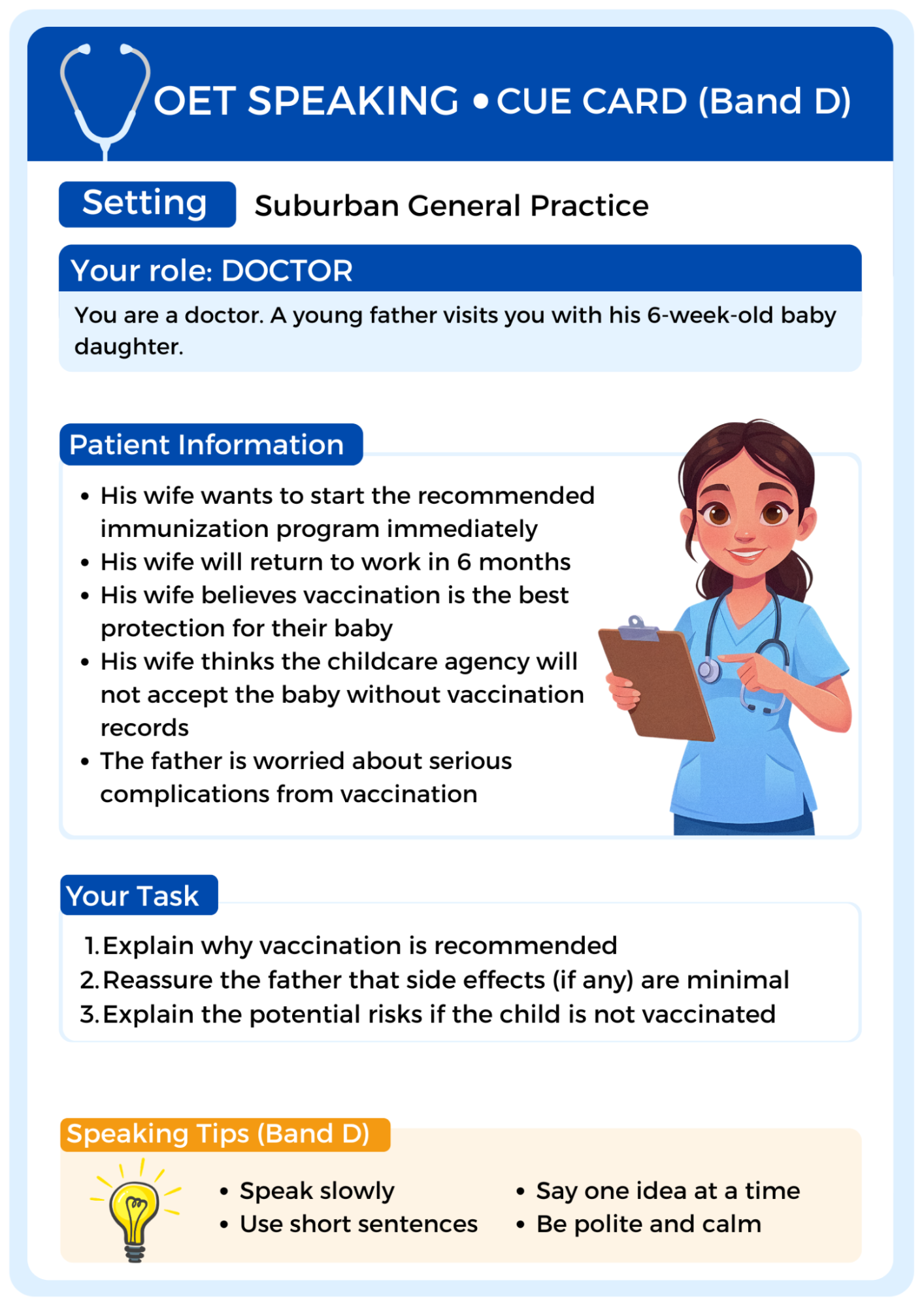
Read the Doctor Cue Card below to guide your practice.
Steps to Use the Chatbot for OET Speaking Practice (as a PATIENT)
- Take a screenshot of the role-play cue card (Patient) and upload it to the chatbot.
- Type the prompt: "Read the attached cue card and guide me to practice."
- Follow the chatbot's guidance step by step:
- Speak one idea at a time
- Use short, clear sentences
- Pronounce words clearly
- Repeat the practice until all tasks on the cue card are completed.
- Read the summary feedback provided by the chatbot.
- Answer the reflection questions about your speaking experience.
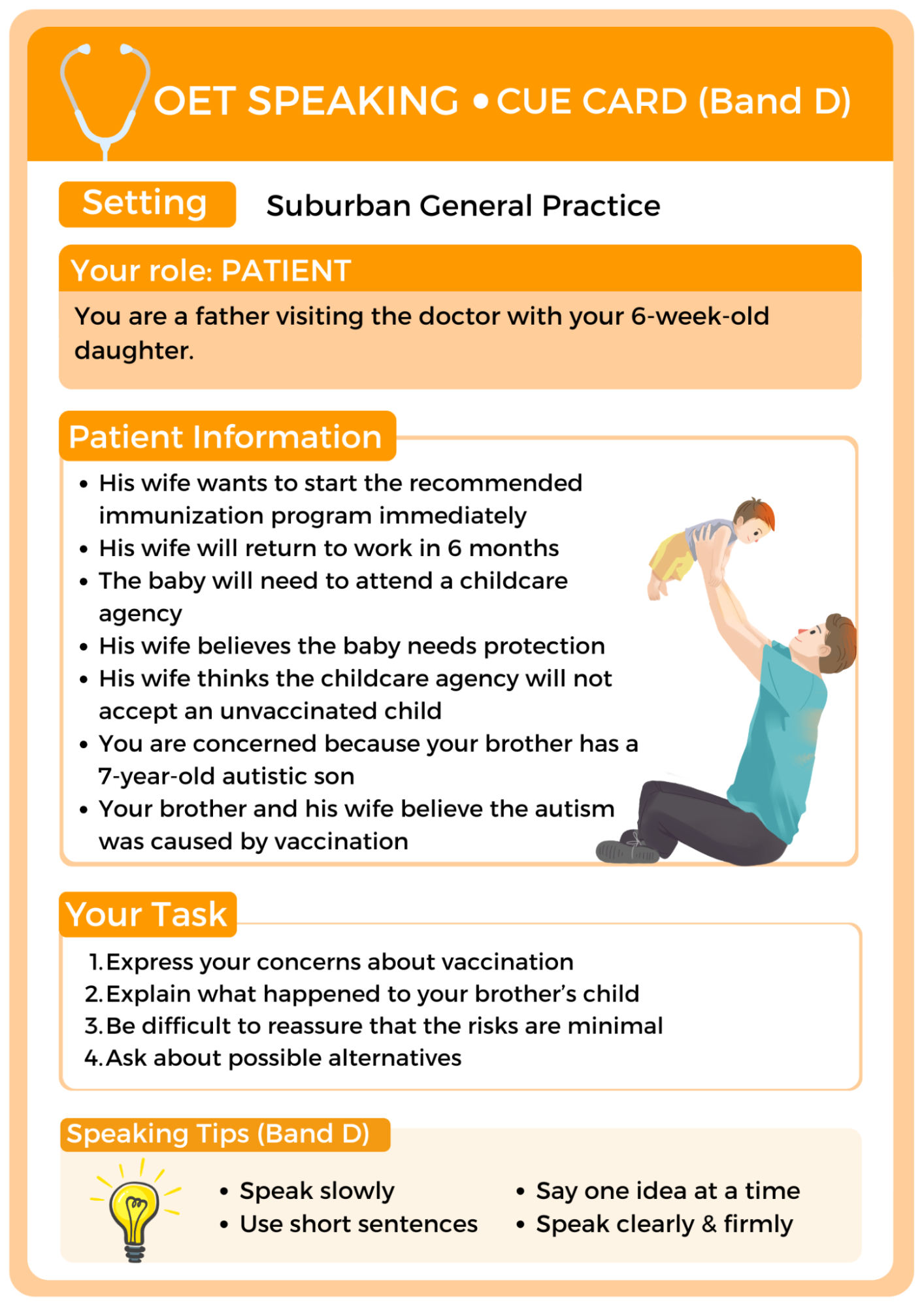
Read the Patient Cue Card below to guide your practice.
Merging Doctor and Patient Responses
Now merge all the responses from the doctor and patient. Upload the new page/file (A complete dialogue between doctor and patient) and use this following prompt:
Prompt: Merge the conversation between a doctor and a patient in the attached file so it becomes a complete dialogue between a patient and a doctor
The result of your work has to be like the example is available here:
📄 View Example DocumentAI CHATBOT AS CONVERSATIONAL PARTNER
🤖 Practice with the AI Chatbot
Use the chatbot to practice fluency, not to learn the rules. dr. OET Speaking, chatbot, will guide you practice.
Scan to open chatbot Steps to Use the Chatbot as a Conversational Partner
- Open your pdf files you uploaded before to help you respond the chatbot
- Upload two cue cards: doctor and patient
- To start, use this prompt:
"Read the attached cue cards and be my conversational partner. You take a role as a patient. I will be a doctor. Make sure your questions are in line with the patient's task in the cue card. Can we start?"
In this context a chatbot functions as conversational partner.
Here is an example of doing roleplay conversation with the chatbot, as speaking partner:
📄 View Conversation Example 💡 Ask the chatbot for feedback:
"Can you provide feedback for my performance as a doctor?"
In-Class Activities
Role-Play with Classmates
In-Class Activities
Introduction to In-Class Activities
After you finish the pre-class and chatbot practice, you are ready to practice in class. At this stage, you will apply what you have learned in real speaking activities. You will practice, get feedback, and improve step by step. These activities help you speak more clearly and communicate better in a clinical situation.
Executing the Role-Play
In this stage, you do a role-play with a partner. One of you is the doctor, and the other is the patient. You use OET-style situations. You try to start, continue, and finish the conversation. You should speak clearly, use simple and appropriate language, and show care to the patient.
Feedback from Lecturer
Feedback from Lecturer
After the role-play, you will receive feedback from the lecturer or tutor. The feedback will look at your fluency, pronunciation, vocabulary, and how you communicate with the patient. Use this feedback to understand what you did well and what you need to improve.
You will be scored based on the following criteria:
| Section | Criterion | Descriptor Focus |
|---|---|---|
| A. Linguistic Competence | Intelligibility | Pronunciation clarity, stress, and intonation Is the speech clear and easy to understand? |
| Fluency | Speech flow, pace, and hesitation Is the speech smooth or full of hesitation? | |
| Appropriateness of Language | Use of patient-friendly and professional language Is the language polite, professional, patient-friendly? | |
| Grammar & Expression | Control and range of grammatical structures Are sentences accurate and varied? | |
| Vocabulary Range | Precision and breadth of vocabulary Is vocabulary precise and appropriate? | |
| Linguistic Subtotal | — | — |
| B. Clinical Communication Competence | Relationship Building | Empathy, rapport, and respect Does the speaker show empathy and rapport? |
| Understanding Patient Perspective | Acknowledgement of patient concerns and feelings Are patient concerns acknowledged? | |
| Providing Structure | Organization and clear signposting Is the conversation organized logically? | |
| Information Gathering | Effective questioning and active listening Are relevant questions asked? | |
| Information Giving | Clarity and usefulness of explanations Is information clear and understandable? | |
| Clinical Subtotal | — | — |
Summary
D. Summary
This chapter strengthened OET Speaking skills by integrating key medical vocabulary, patient-friendly grammar, and empathetic communication strategies. Through a flipped classroom supported by AI tools, students progressed from recognizing language forms to creating complete, confident, and compassionate OET role-plays aligned with Band D–C expectations.
Formative Assessment and Evaluation
Now, you are ready to create a role-play video based on the same case. Your role-play should take into account the feedback from your lecturer so that it improves on your previous performance. Your video submission will be assessed by your lecturer.
Your performance is scored from 1 to 6, with each level having a descriptor: 1 is very poor, 2 is poor, 3 is limited, 4 is adequate, 5 is good, and 6 is excellent. If you get a score of 4 (adequate), it means you can communicate well enough to continue to the next level. You can also move forward if you get 5 (good) or 6 (excellent), as your communication is strong. However, if you get 1 (very poor), 2 (poor), or 3 (limited), your communication is still not enough, so you need to do remedial roleplay to practice and improve before you can continue.
Reflection
F. Reflection
Answer the following questions by filling in the reflection form below:
Language Reflection
- Which vocabulary felt most useful today?
- Which grammar structure helped me sound more professional?
- Which part of the learning process do you find interesting? And why?
Personal Reflection
- How confident did I feel speaking today?
- One improvement I will focus on next time is?
- How will I improve it?
AI Chatbot Reflection
- Does the chatbot help me improve?
- How does the chatbot improve it?
References
- Bhalla, R. (2011). Essential Speaking Strategies Doctors. Scribd.Com. https://www.scribd.com/document/57428157/Essential-Speaking-Strategies-Doctors?utm_source
- Eric H. Glendinning, B. A. S. H. (2005). English in Medicine 37131057416729 (3rd ed., pp. 5–32). Cambridge Professional English.
- Www.occupationalenglishtest.org. (n.d.). Speaking sub-test: Assessment criteria and level descriptors (pp. 1–2). https://cdn-aus.aglty.io/oet/pdf-files/Speaking assessment criteria and level descriptors.pdf
- Yovinalls, A. (2018). The Speaking Task. In Official Guide to OET (Kaplan the Official Guide to Oet) (pp. 157–168).