Medical English (Beginner Level)
A structured learning platform for healthcare professionals preparing for the Occupational English Test (OET).
Course Description
Medical English (Beginner Level) is a course designed to equip health science students with foundational English communication skills aligned with the Occupational English Test (OET). The course covers Listening, Reading, Speaking, and Writing skills in authentic healthcare contexts such as patient consultations, clinical instructions, medical texts, and referral letter writing. Through a Flipped Classroom approach integrated with Artificial Intelligence (AI), students engage in independent, collaborative, and interactive learning activities including role-plays, discussions, simulations, and problem-solving tasks. The course emphasizes Deep Learning competencies (C1–C6) to help students develop effective medical communication skills and progress from OET Band D toward Band C.
Course Learning Outcomes
CLOs & Sub-CLOs
CLO
Students are able to understand and apply foundational Medical English skills in Speaking within healthcare contexts through an AI-integrated Flipped Classroom approach, enabling them to communicate effectively, empathetically, and professionally in simple clinical situations.
Sub-Course Learning Outcomes
- Students independently identify the structure and criteria of OET Speaking role-plays in healthcare contexts.
- Students independently explain patient-friendly vocabulary, grammar, and empathy strategies related to healthcare cases such as pregnancy care, heart problems, diabetes, vaccination, and epigastric pain.
- Students independently apply appropriate language and empathetic communication in structured OET Speaking role-plays and clinical simulations.
- Students collaboratively analyze patient needs and emotional cues during role-play activities and provide constructive peer feedback.
- Students evaluate and reflect on their speaking performance by identifying useful vocabulary, grammar improvement, speaking confidence, and areas for further development.
- Students produce clear, empathetic, coherent, and patient-centered OET role-plays using appropriate clinical communication strategies.
English Learning Model
A Chatbot-Augmented Flipped Learning Framework
A Chatbot-Augmented Flipped Learning Framework is a technology-enhanced instructional framework that integrates flipped learning, AI chatbot scaffolding, collaborative role-play, lecturer feedback, and reflective learning to support the development of linguistic and clinical communication competence. The framework provides a systematic, interactive, and student-centered learning environment in which students actively engage in authentic healthcare communication tasks while continuously improving their speaking performance. This framework is particularly suitable for OET-oriented instruction and EMI healthcare education contexts because it promotes flexibility, personalization, interaction, and deep learning within a structured instructional process.
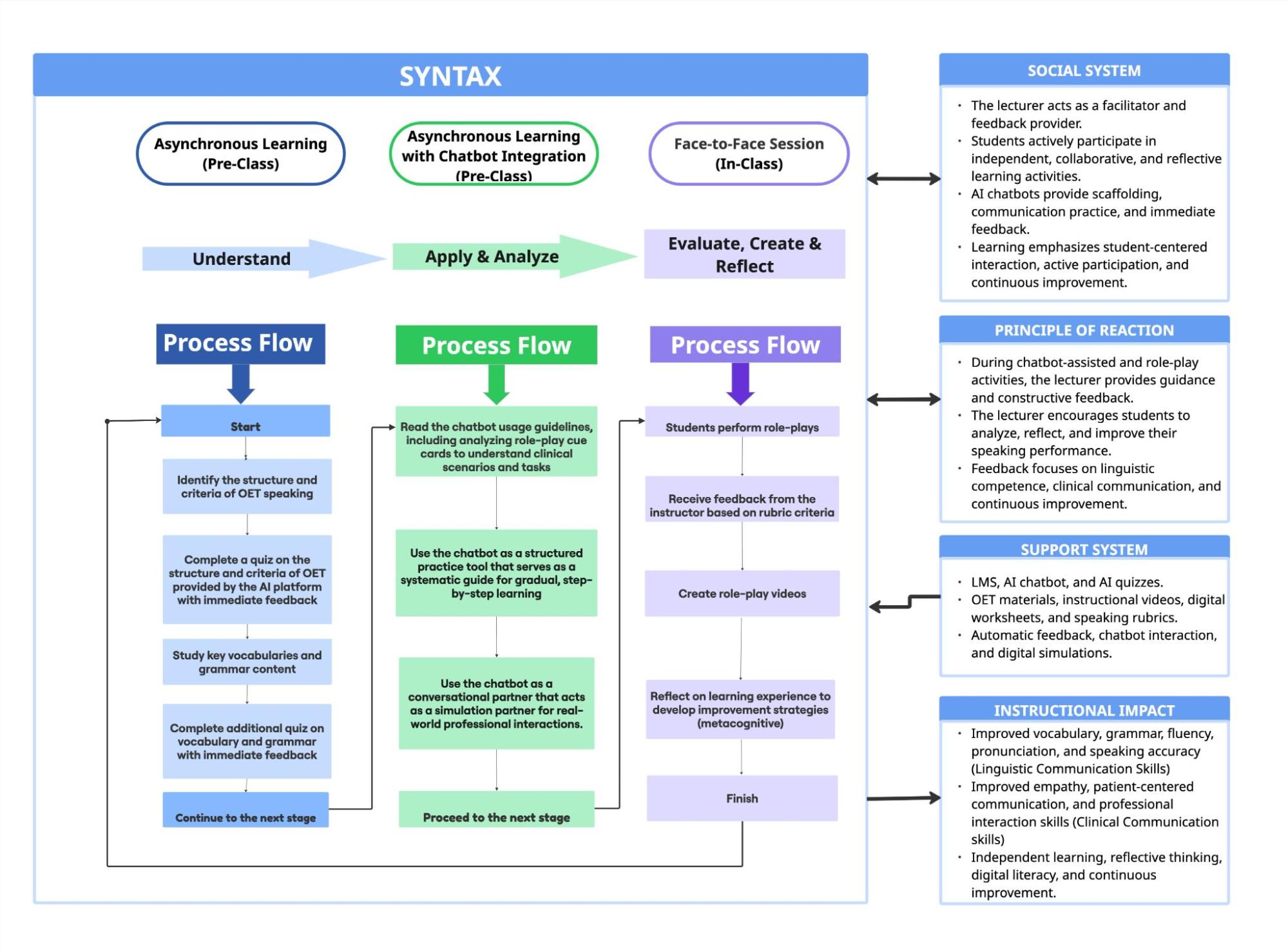
Phase 1 — Understanding Basic Knowledge
a) Preparing Learning Materials
In this phase, students independently study English learning materials provided through the LMS and AI platform. The materials may include videos, vocabulary lists, grammar content, role-play cards, and interactive quizzes. Students learn the structure and criteria of OET speaking and clinical communication.
b) Initial Self-Learning
In this phase, students complete self-paced learning activities to build their understanding of linguistic and clinical communication knowledge. Students may also receive immediate feedback from the AI platform during the learning process.
Phase 2 — Chatbot-Assisted Practice
c) Practicing with AI Chatbot
In this phase, students use AI chatbots as learning partners and scaffolding tools. The chatbot guides students step-by-step in understanding clinical scenarios, analyzing role-play tasks, and practicing communication strategies.
d) Applying and Analyzing Communication
In this phase, students interact with conversational chatbots to practice English communication in simulated healthcare situations. Students apply linguistic knowledge, analyze communication tasks, and receive automatic feedback to support gradual improvement before attending the classroom session.
e) Collaborative Role-Play Practice
In this phase, students perform collaborative role-play activities with classmates based on OET-style clinical communication scenarios. Students practice using clear, polite, empathetic, and patient-centered communication in English.
f) Feedback, Creation, Reflection & Improvement
In this phase, the lecturer provides feedback on students' speaking performance, including fluency, pronunciation, vocabulary, and clinical communication skills. Students reflect on their learning experience, evaluate their performance, and identify strategies for continuous improvement and deep learning.
Syntax
| Activity | Lecturer Activities | Student Activities |
|---|---|---|
| Before Class Phase 1 – Asynchronous Learning: Understanding Basic Knowledge | ||
| Preparing Learning | The lecturer provides English learning materials through the LMS and AI platform, such as videos, vocabulary lists, grammar explanations, OET speaking guidelines, and communication examples. |
Students independently study the learning materials provided through the LMS. Students read, watch, and understand the materials related to OET speaking and clinical communication. |
| Initial Self-Learning | The lecturer prepares self-paced learning activities and quizzes through the LMS and AI platform. The lecturer also provides automatic feedback to support students' understanding before class. |
Students complete self-learning activities, vocabulary exercises, grammar practices, and quizzes independently through the LMS and AI platform. Students review the automatic feedback to improve their understanding. |
| Before Class Phase 2 – Asynchronous Learning with Chatbot Integration: Apply, Analyze | ||
| Practicing with AI Chatbot | The lecturer provides chatbot-guided speaking practice activities and role-play instructions through the AI platform. The lecturer monitors students' learning progress during chatbot interaction activities. |
Students use AI chatbots as learning partners to practice communication step-by-step. Students analyze clinical scenarios, understand role-play tasks, and practice speaking using guided chatbot interaction. |
| Applying & Analyzing Communication | The lecturer facilitates chatbot-based communication simulations and provides guidance for analyzing communication strategies and language use. |
Students interact with conversational chatbots to simulate healthcare communication situations. Students apply linguistic knowledge, practice communication strategies, and analyze their speaking performance based on chatbot feedback. |
| Face-to-Face Session (In Class): Evaluate, Create, Reflect, Improve | ||
| Collaborative Role-Play Practice | The lecturer organizes collaborative role-play activities and provides instructions related to OET-style speaking tasks. The lecturer observes students' speaking performance during role-play activities. |
Students perform collaborative role-play activities with classmates based on clinical communication scenarios. Students practice using clear, polite, empathetic, and patient-centered communication in English. |
| Feedback, Creation, Reflection & Improvement | The lecturer provides feedback on students' speaking performance, including pronunciation, fluency, vocabulary, and clinical communication competence. The lecturer guides students in reflecting on their learning process and identifying improvement strategies. |
Students receive feedback from the lecturer and reflect on their speaking performance and create a role-play video. Students identify their strengths and weaknesses and develop strategies for continuous improvement and deeper learning. |
Developed By
Doctoral Program in Educational Technology, Graduate School, Universitas Negeri Jakarta

Emilius German
Doctoral Program in Educational Technology, Graduate School, Universitas Negeri Jakarta

Basuki Wibawa
Doctoral Program in Educational Technology, Graduate School, Universitas Negeri Jakarta

Mohamad Syarif Sumantri
Doctoral Program in Educational Technology, Graduate School, Universitas Negeri Jakarta